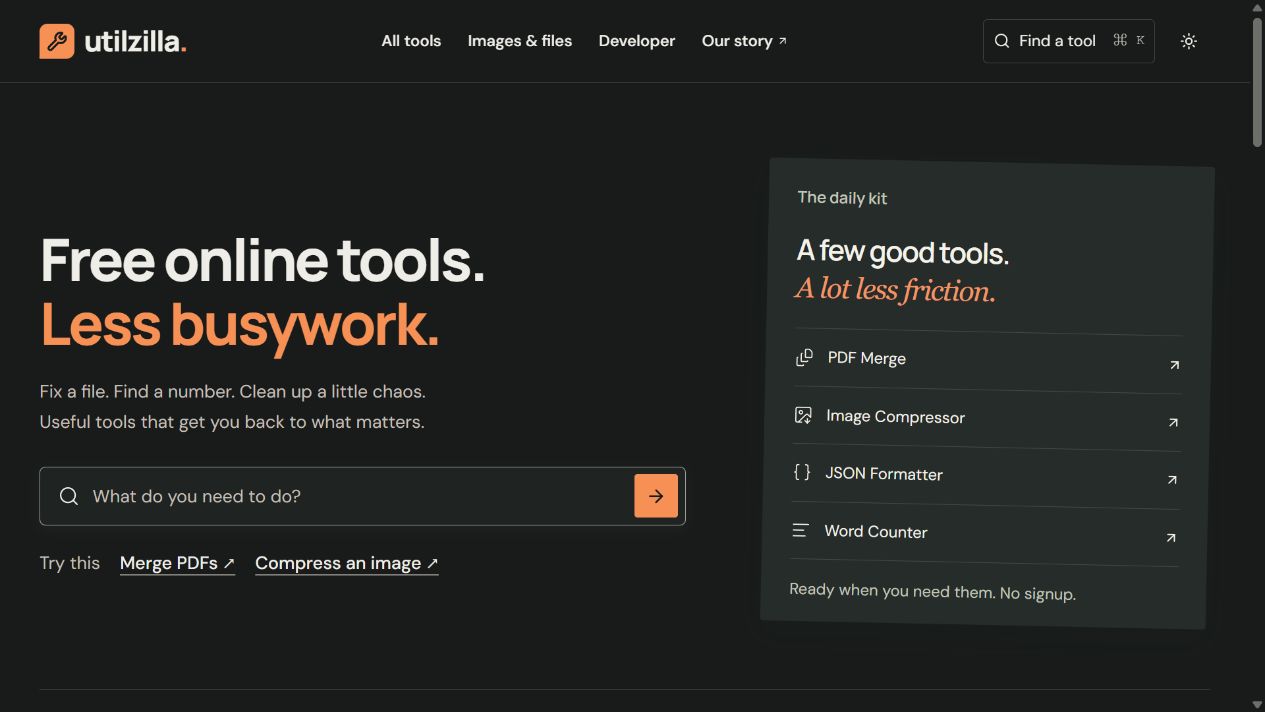
Everyday tasks often mean switching between single-purpose tools. UtilZilla brings common utilities into one searchable collection.
My contribution
I maintain a React and Vite application with Wouter routing, shared layouts and a registry of 111 tools in the reviewed source. Build-time metadata gives individual routes their own titles, descriptions and social previews.
Architecture trade-off
Browser-side tools keep many everyday transformations close to the input. Server-backed capabilities still need their own boundary; the product should not imply that every operation is local or private by default.
Verification and limits
The source includes regression checks for time zones and generated outputs. The live homepage and registry were reviewed for these notes; that is not an exhaustive audit of all 111 tools.
Available at utilzilla.com. Coverage evolves; no adoption or revenue claims are made here.
02 / Developer tooling
Signalhead
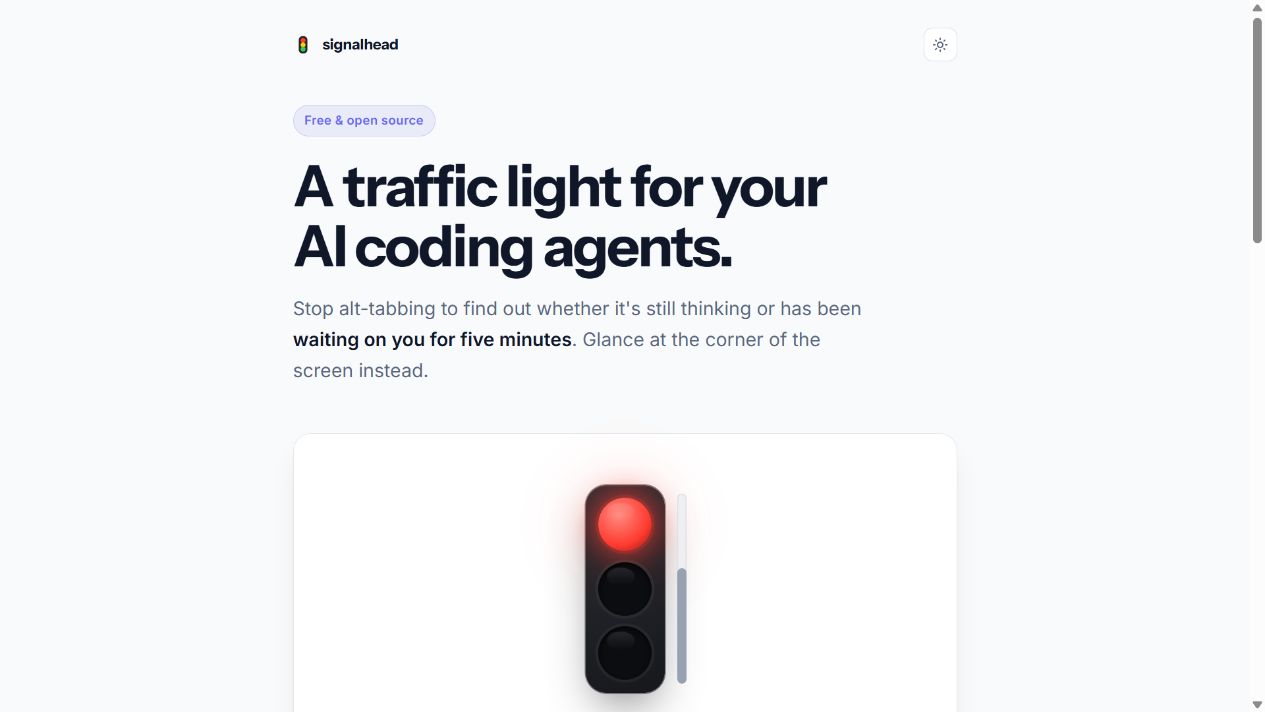
A desktop traffic light for AI coding agents: see when an agent is working, waiting or finished.
Coding agents run while you work elsewhere. Repeatedly switching windows to check their status interrupts that work.
My contribution
A local status server, command-line tooling and desktop overlay connect agent events to visible priority states using server-sent events.
Architecture trade-off
A local server and event stream separate agent integrations from the overlay. That keeps display logic focused, but makes connection health and diagnostic feedback part of the product experience.
Verification and limits
My contribution spans the status tooling, overlay and public project documentation. The public repository includes cross-platform CI and release v1.5.0. The pictured documentation demo is not proof of a live agent session or every platform behaving identically.
Public project with a published release. Native overlay behavior still needs platform-specific visual review.
03 / Interface design
Ritam UI
A personal design system for purposeful, consistent web interfaces.
Design systems
React
Accessibility
Flame & InkControl states
Enter a valid email address.
Actual Ritam components · visual specimen
The problem
Reusable UI needs a clear visual language and predictable interaction patterns, especially when building several products.
My contribution
I built the design system using Codex and set its Flame & Ink direction: orange primary actions, neutral surfaces and Plus Jakarta Sans. This portfolio integrates its actual React controls at build time.
Architecture trade-off
Rendering components into static HTML reuses the visual system without shipping its JavaScript to visitors. A pinned compiled snapshot makes that dependency explicit, but a fresh source build still needs the approved private artifact.
Verification and limits
This integration passed a production build, 98 static-site assertions and actual desktop/mobile navigation checks. Review caught and corrected clipped mobile navigation. Those checks do not establish complete design-system accessibility.
Private release candidate. The package is unpublished, and upstream release checks remain separate from this portfolio integration.
04 / Product experiment
thisweek.lol
An evolving web experiment, now being reshaped around meme news.
How can a weekly format make discovering and sharing timely content more engaging? The product is currently being reworked around meme news.
My contribution
I am reshaping the Next.js and TypeScript experiment into a local meme-news demo. Earlier iterations explored a weekly promotion board.
Architecture trade-off
A local demo lets the browsing and submission experience be reviewed before committing to live publishing, accounts or payments. It does not validate a production content pipeline or business model.
Verification and limits
The current focus is clear content hierarchy, interaction feedback and responsive browsing. This portfolio documents the direction rather than claiming production validation for the new demo.
Local redesign in progress. The live domain may show the earlier iteration; the new demo is not a live paid business.